Speaking Up About Religious Terrorization

If you grew up in a religious authoritarian home, there’s a good chance you weren’t allowed to celebrate Halloween — but that doesn’t mean you didn’t have countless chances to be scared in your childhood. We thought it’d be a good month to talk about religious terrorization of children, a term for when children are given religious ideas (like hell, end-times, Satan or demons) that genuinely terrify them and have long-term impacts on their mental health — and highlighting those who have spoken up about it!
DL posted on social media asking what religious themes people found terrifying in childhood, and they received over 1000 comments (and it’s still going)! Here were some of the biggest themes:
- Satan and Demons
- No internal privacy from god
- Martyrdom (dying for your faith)
- Hell (for yourself, or for those you cared about)
- Violent stories in the Bible, especially stories about kids being threatened with death (Abraham and Isaac, Solomon and the baby)
- The End Times
- Jack Chick tracts
- The rapture (and being left behind)
- A judgmental, wrathful God
- Eternity Itself (Apeirophobia)
- Committing blasphemy or “the unforgivable sin”
- The Crucifixion of Jesus
- The film Thief in the Night

In our latest patreon episode, we talk about how these concepts impact children and how they impact you into adulthood. And this is just a limited list — there are endless examples because high control religion operates on a foundational principle of: you are not safe without us. High control religions of all stripes use supernatural threats to maintain control over members, prompting obedience for fear of consequences like hell or demon possession. However, there are always scary theologies that function not just to threaten, but to elicit emotional engagement — for example, explaining to children in minute detail about the incredible pain of being crucified and then telling children that they caused Jesus had to experience that excruciating pain.
While spanking as a method of control was (usually) only used on children, the threat of supernatural harm is used on the whole community. But while it makes a sort of sense that adults who have experienced trauma are drawn into communities that promise safety if the rules are followed, it’s different for children. For those of us born into high control religions, in addition to worries about being spanked or other types of punishment, these spiritual themes coerce children into obedience by terrorizing them first and then offering the safety of committing more to the group.
It also discourages children from stepping outside the rigid rules of the group because of what might happen to them should they do so. If you disobey God or forget to pray at night for everyone you love — you might end up tortured for eternity, or left behind during disastrous end times, or become possessed by a demon, or be responsible for other people going to hell.
A History of Naming Religious Terrorization
Society (including the psychological community) has largely considered religion to have positive psychological impacts, while ignoring the aspects that are harmful. This seems to be especially true when it comes to the impacts on children, who don’t have a voice to communicate what is harmful, and who often forget or downplay them by the time they reach adulthood. Christianity is privileged and prioritized in the United States, which has also impacted the lack of research on the developmental harms of the practices and beliefs of patriarchal authoritarian religion.
However, much like Mr. Rogers, there are some that have not forgotten what it’s like to be a child, including the utter vulnerability and intense sensitivity children have to danger, and the way this makes them more at risk of coercive control. As the emphasis on hell increased in conservative Christianity in the US throughout the 20th century, there were some who spoke out about the harm that these concepts could have on the minds and bodies of children.
Because of the lack of research, this month we wanted to take a moment to recognize and honor the work of those who have spoken up about the problem of the religious terrorization of children in the past few decades, and how each of them have thought about the practice.
Janet Heimlich
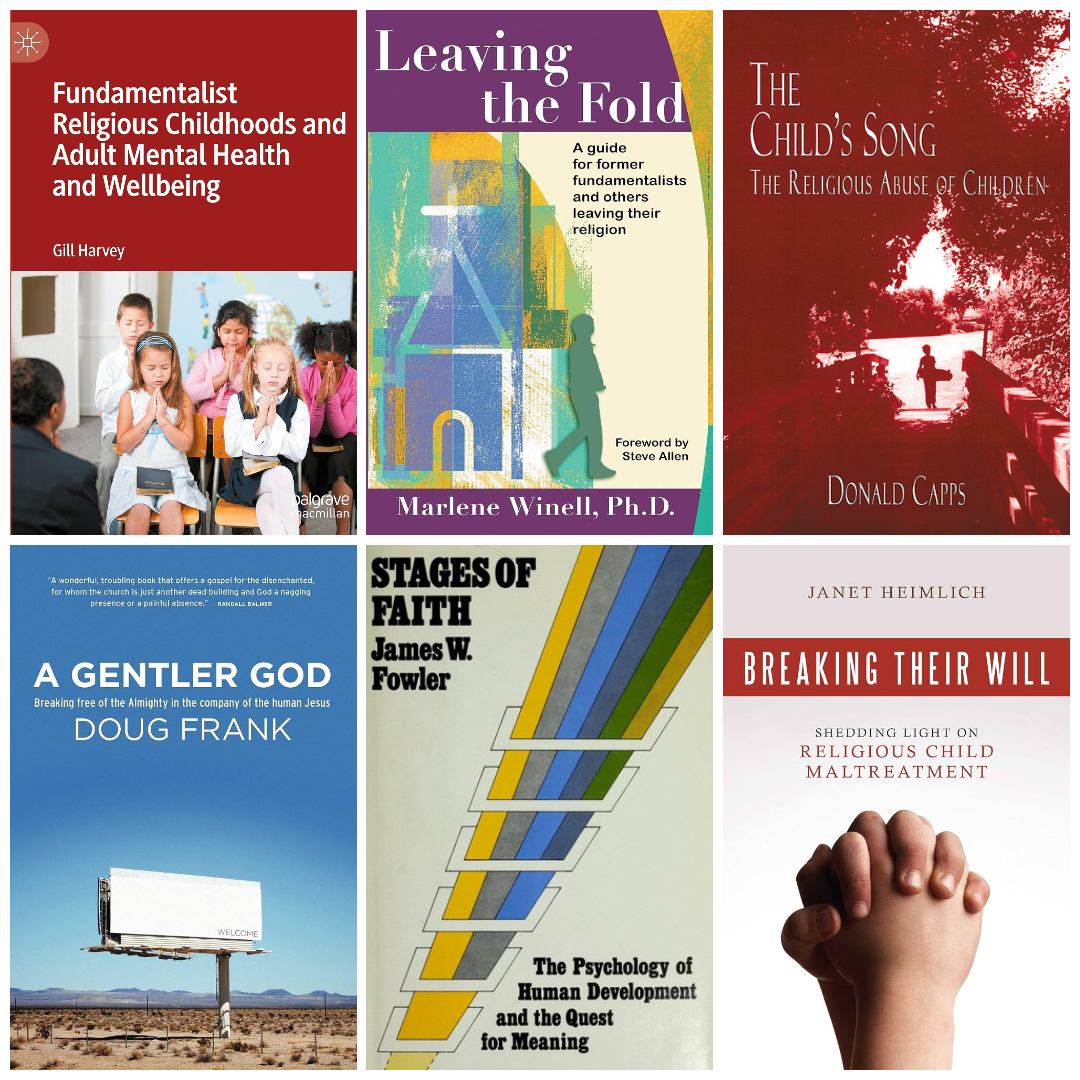
While she didn’t create the term religious terrorization (and there’s no clear origination), Janet Heimlich defines it in her book 2011, Breaking Their Will: The Religious Maltreatment of Children. She is an independent journalist, brought up with “next to no religion,” (1) who decided to write a book on religious child maltreatment, as she began to see the many socially-accepted ways that religion is employed to abuse and neglect children.
She defines “religious terrorization,” as when children are "bombarded by scary ideas: that they must fear God, that eternal damnation or spiritual death waits apostates, that demons and the devil are eager to possess them, or at the end times, Armageddon, or other apocalyptic events are imminent" (2). Naming how very scary these ideas are is incredibly important, because what is seen as simply “Sunday school” or any other form of religious education, can actually be an incredibly emotionally stressful experience for a child, both when they are taught about it, and as they ruminate on it at other times (something we’ve heard very often from religious trauma survivors).
Heimlich also includes other experiences in religious terrorization. She includes “placing a child in an unpredictable or chaotic or recognizably dangerous situation”(3). Take a minute and reflect on your experiences: were you ever placed in religious situations that felt unsafe in your childhood or adolescence? It’s not uncommon to give teenagers an emotionally impactful (that is, manipulative) experience that plays on their sense of fear, such as hell houses, persecution-themed role plays or even "experiential exercises” like ropes courses that are geared to engage a fear response. For some, being in a charismatic service or where people are yelling or engaging in unpredictable behavior can be a terrorizing experience.
Hemlich also writes that religious terrorization can include “setting rigid or unrealistic expectations with the threat of loss, harm or danger…”(4). Many children feel that they have to be a “good Christian,” or “fully believe,” if they are to be saved from hell. Despite all the talk about forgiveness and grace, so many of us raised in the church implicitly knew that we needed to follow the strict church guidelines or we were in danger of hell or other spiritual harms.
Donald Capps
Donald Capps was a professor of pastoral theology at Princeton Theological seminary and specialized in the psychology of religion. Also worth noting for our audience, he was a vocal ideological opponent of James Dobson. In 1991, he gave the presidential address at the Society for the Scientific Study of Religion, and titled his talk: “Religion and Child Abuse: Perfect Together.” In a society that promoted the idea that religion was almost always beneficial, Capps was curious about the ways it had been harmful to children and how their voices had been systematically ignored.
As he said, “many religious ideas that children are taught cause them emotional torment and therefore are inherently abusive” (5). He believed that concepts like hell caused mental agony for children who had to live with its possibility living in their vivid imaginations, and he noted that while these ideas are not physically painful, they are psychologically torturous, and he believed that “religious ideas may be as abusive as the physical punishment of children in the name of religion” (6).
Capps’ book The Child’s Song: The Religious Abuse of Children, analyzes Augustine’s life and theology, tracing the long history of spiritual harm to children back to his own experience of corporal punishment as a child and how he used it to create a theology that would impact centuries of theology. I appreciate most that Capps recognizes the significance of a child’s inner life and what occurs in their mind. In a world that often dismisses the experiences of children, and only notices them when their behavior becomes a problem, Capps stepped into a child’s shoes and considered how absolutely terrifying many of these religious concepts are.
Doug Frank
Doug Frank is a theologian, and author of one of Krispin’s favorite books, A Gentler God (make note, it is a Christian theology book, but Part 1 is an incredibly accurate psychological assessment of evangelical Christianity). In his book, Frank traces the beginnings of American evangelicalism, the theologians who founded it and how their life experiences shaped the religious tradition that they began.
He writes about how evangelical theology undermines a sense of safety, as we live under the intense scrutiny of a perfectionist God who can see not only our every deed but also our every thought. He asks readers, ”Did you feel safe knowing that a holy, righteous and powerful God was hearing your every thought, examining your every move? Did you feel affirmed and supported, exactly as you are?”(7).
Frank explains how both threats of hell and the supernatural surveillance of a judgmental God increased in the evangelical church during a century where Christianity was losing societal influence. In order to keep teenagers in the fold, they used “grim descriptions of death and hell and the severe Judge who was bound by his nature to send his beloved children…straight into flames if they didn’t behave” (8). He explains how the terrors of hell functioned not only to keep teenagers in church pews, but to force teenagers to suppress normal parts of human development in an exhausting, never-ending endeavor to “true devotion.” He wrote about how adolescents’ sense of safety came second to the demand for their compliance.
James Fowler
James Fowler is famous for his developmental model that tracks the stages of faith throughout the lifespan, now referred to Fowler’s Stages of Faith. While usually uncritical of the negative impacts of religion, he did at times talk about how harmful religious terrorization can be. In his 1981 book, Stages of Faith: The Psychology of Human Development and the Quest for Meaning, he writes that for every child who is helped by faith, another is harmed, which he calls, “the brutalization of souls” (9). He criticizes groups who subject children to “the kind of preaching and teaching that vividly emphasize the pervasiveness and power of the devil, the sinfulness of all people without Christ and the hell of fiery torment that await the unrepentant.” He writes, “This kind of formation—and its equivalent in other religious traditions—can ensure a dramatic ‘conversion experience’ by the time the child is seven or eight,” he says, “It runs the grave risk, however,” of leading to “precocious identity formation,” (10) an unhealthy outcome in which children are psychologically manipulated into taking on their parents’ beliefs rather than being given support to find their own spiritual path (11). He also notes the emotional cost of this kind of conversation experience, causing both childhood fear and rigidity. In other words, he worried that kids would experience fear, become perfectionistic, and take on a faith just because their parents pressured them to — all things we commonly see among those who grew up in a high control religion.
Marlene Winell
Marene Winell wrote one of the first books on religious trauma titled, Leaving the Fold, back in 1993. Her book is full of insights about healing from religious trauma, and she explicitly talks about how harmful threats of hell are for children. She writes, “Especially for children, with their vivid imaginations and unclear notions of reality, the imagery of a fiery hell is intensely frightening,” and points out that “a parent threatening a child with such tortures before death can easily be seen as abusive…But fundamentalist preachers have no shame about describing with relish the 'weeping and gnashing of teeth' that God will mete out to sinners.”(12) “weeping and gnashing of teeth” that God will mete out to sinners.
She believes that such early conditioning “may have filled your [younger] mind with terror,” setting up a child for life-long perfectionism. “In a child’s way of thinking,” she writes, “it makes sense for the world to be black and white, for there to be a war between good and evil, and for behavior to deserve reward or punishment…small children are especially vulnerable to this and can incur long-term damage to their feeling and thought patterns" (13).
In her book, Winell does a great job of naming the dynamics and experiences that happen to children, that in any other setting, would be considered abusive or neglectful, and we’re grateful for the ways she’s contributed to the conversation about how religion can harm children.
Gill Harvey
Gill Harvey is a UK-based therapist and researcher who just released a new book in 2026 titled Fundamentalist Religious Childhoods and Adult Mental Health and Wellbeing, a fantastic new academic work that summarizes research on how fundamentalism impacts kids (and the adults they grow into). She believes that “[research] literature as a whole can be criticized for generally having a bias towards a positive impact” (14) of religion, overlooking the negative impacts.
She shares her own experience of growing up, writing “I was confused because while I was taught that God was loving, He would punish me by consigning me to hell for minor misdemeanors. I lived in constant fear, hyper-aroused and hypervigilant to stay safe, with adrenaline constantly flooding my system" (15). She cites research about how children’s nervous systems are regulated by the presence of parents and absence of threat, speculating that the presence of supernatural threat undermines the child’s ability to experience a true sense of safety, writing, “This demonstrates that even if biological parents are physically present, the child’s nervous system may still be alert” (16). She brings an updated neuropsychological perspective to religious terrorization, considering how it impacts a child’s nervous system, and how that might impact them during developing years.
Legacy of Fear and Rigidity
These writers have all contributed important work to understanding the psychological impacts of religious terrorization on children, and while they come from different disciplines across different decades, they all observe at least one (if not both) of two main themes: these ideas create real distress in children in a way that adults often overlook, and the outcome tends to be adopting a rigid, perfectionistic way of approaching life.
At STRONGWILLED, we hope to continue their work, as a community together, we continue to share our experiences of religious terrorization that are often lost to the memories of childhood. Donald Capps reflected on the ways adults forget how difficult religious childhood is, “All of my companions had partially or totally forgotten about these experiences. However, as more and more details emerged, they discovered that they had powerful feelings about the torment they had suffered, feelings of deep sorrow and pity for the child each once as, and a rage at the person or persons who had promulgated the religious idea”(17). We know that whether you’ve forgotten, or if it’s been front of mind all along, remembering what it’s like to be a kid in a scary religious environment brings up big, important feelings and we hope that you join us in remembering and speaking about this experience.
And if you'd like to hear our subscriber-0nly podcast about the religious terrorization of children, you can sign up for a paid subscription either here at www.strongwilledproject.com or head over to the STRONGWILLED patreon.
//
On this post, paid subscribers can comment, but anyone is able to view comments, so we wanted to note that this is a public space.
STRONGWILLED is not a therapeutic space, and we encourage folks to find counselors or mental health experts to continue unpacking these topics with — and make sure to take care of yourselves when interacting with these triggering topics.
- Heimlich, 2011, Breaking Their Will: The Religious Maltreatment of Children. p. 16.
- Heimlich, 2011, Breaking Their Will: The Religious Maltreatment of Children. p. 141-142.
- Heimlich, 2011, Breaking Their Will: The Religious Maltreatment of Children. p. 142.
- Heimlich, 2011, Breaking Their Will: The Religious Maltreatment of Children. p. 142.
- Capps, 1995, The Child's Song: Religious Abuse of Children. p. 51.
- Capps, 1995, The Child's Song: Religious Abuse of Children. p. 52.
- Frank, 2010, A Gentler God: Breaking Free of the Almighty in the Company of the Human Jesus. p. 137.
- Frank, 2010, A Gentler God: Breaking Free of the Almighty in the Company of the Human Jesus. p. 137.
- Fowler, 1981, Stages of Faith: The Psychology of Human Development and the Quest for Meaning, p. 132.
- Fowler, 1981, Stages of Faith: The Psychology of Human Development and the Quest for Meaning, p. 132.
- Fowler, 1981, Stages of Faith: The Psychology of Human Development and the Quest for Meaning, p. 132.
- Winell, 1993, Leaving the Fold: A Guide for Former Fundamentalists and Others Leaving Their Religion, p. 95.
- Winell, 1993, Leaving the Fold: A Guide for Former Fundamentalists and Others Leaving Their Religion, p. 194.
- Harvey, 2026, Fundamentalist Religious Childhoods and Adult Mental Health and Wellbeing, p. 13.
- Harvey, 2026, Fundamentalist Religious Childhoods and Adult Mental Health and Wellbeing, p. 6.
- Harvey, 2026, Fundamentalist Religious Childhoods and Adult Mental Health and Wellbeing, p. 6.
- Capps, 1995, The Child's Song: Religious Abuse of Children. p. 53.